DESK – Develop, Evaluate and Save Knowledge: Wissensmanagement in Bildungseinrichtungen

Partners:
Max Eyth School Stuttgart, Germany
Fachberufsschule Villach 1 (vocational school), Austria
Vocational School for Telecommunications Sofia, Bulgaria
Technical University Sofia, Bulgaria
Angel Kanchev Rousse University, Bulgaria
PGO Rousse, Bulgaria
Solski Center Nova Gorica, Slovenia
Goal:
This project aims at assessing the individual, existing regional (eg organisational) needs of the educational organisations (WP1) and developing an institutionally and culturally appropriate concept for sustainably securing and disseminating the knowledge of the organisations. In doing so, it will take into account the best practices and lessons learned from other industries. In parallel, an accompanying organisational development and change management concept will be developed and agreed with the partners (WP2). Initial field trials will test the concepts and – if the time scale of the project allows – evaluate them (WP3). The findings will subsequently be summarised and placed at the disposal of both the education ministries and the affiliated vocational training and industrial partners in the form of guidelines and methodological toolboxes. In parallel, the concepts will be spread nationwide in the educational systems of the partner countries.
Description:
In preparation for the already immanent challenge posed Europe-wide by demographic changes, it is essential to develop culturally and systemically aligned, innovative concepts in order to secure the long-term competitiveness of the vocational training systems in the member states of the European Union.
As the knowledge, creativity and efficiency of the human resources/human capital represents one of the most important European resources, securing and expanding these resources is of special significance. Besides the concepts of life-long learning, increased flexibility in deployment and sustainable health promotion, a systematic and organisation-specific knowledge management plays a special role in meeting this challenge.
For educational institutions, too, this topic is becoming increasingly important. In order to entrench and further enhance the competitive advantages of any educational system in the long term, the skills and – particularly in vocational schools – the practical knowledge and process expertise of the staff must be systematically secured and made available as organisational knowledge.
Currently, almost one in two teachers is over 50 years old, with the average age already reaching +/-50 years, too. The resulting outflow of knowledge that can be expected in the near future is therefore immense.
Next steps:
- Transnational Workshop 3
The concepts will be tested in pilot projects at suitable vocational schools in partner countries, the effects will be measured and the impressions and experiences gathered will be documented. - Transnational Workshop 4
Guidelines and a methodology toolbox will be provided to support schools and educational institutions that are interested. In addition, a multiplier concept will be developed. - Multiplier Event
Final conference and publication of findings, establishment of an international network for dissemination and for a sustainable exchange of experience (possibly for providing experts to evaluate and implement projects).
Tasks of the Landesakademie:
Project management:
- Planning, coordination, organisation, supervision, implementation and evaluation of the individual project steps
- Communication with and between the project partners
- Planning and coordination of transnational workshops
- Budgeting of the project
Person in charge:
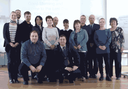
Consortium at a meeting at the Landesakademie
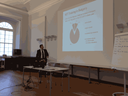
Presentation about vocational education and training in Bulgaria
next Romania

abb.jpg

consortium2.png
Bildungsserver
Baden-Württemberg
Zwischenspurt Deutsch - Clever ans Ziel
QR Code scannen, um den Inhalt online anzusehen.